
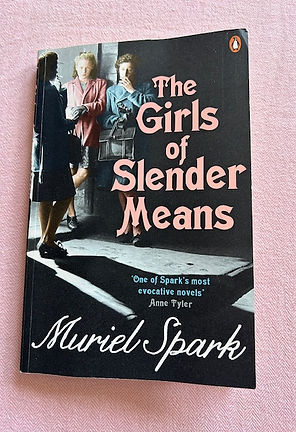

THE GIRLS OF SLENDER MEANS
BY MURIEL SPARK
142 Pages
With the release of "Like a Cat Loves a Bird: The Nine Lives of Muriel Spark", an exciting new biography of Muriel Spark by James Bailey, the Den decided to read one of her lesser known novels, 'The Girls of Slender Means". It’s 1945 in Kensington, London and the aftermath of WWII. The ‘May of Teck Club’ is a tall house facing the Albert Memorial in Hyde Park. It has suffered a barrage of war poundings but remains habitable for the time being and now “exists for the Pecuniary Convenience and Social Protection of Ladies of Slender Means below the age of 30 years who are obliged to reside apart from their Families in order to follow an Occupation” .
Muriel Spark offers a sharp, keenly observed and humorous insight into the interior of this house where an eclectic group of young single women reside and work – the focus and talk always veering around love and money. It was a time of sharing rations and clothes coupons, dressing up to go out with men, elocution lessons and wondering what futures lay ahead. Boy-friends were allowed to dine as guests for a small cost and one of the favourite rumours was that there remained an unexploded bomb in the garden.
The story however begins several years later with one of the former residents, Jane, now a women’s columnist, shares the news that Nicholas Farringdon, who had been a regular visitor to the 'May of Teck Club,' has been tragically killed in Haiti whilst working as a missionary. Nicholas was a rather arrogant, bohemian poet who Jane introduced to the club. The women were in awe of this handsome man with his alternative, political views. Similarly Nicholas was infatuated with all the young ladies, particularly the beautiful, tall and rather austere Selina Redwood. There are regular references to an incident ‘on the roof’ to which access could only be gained by the slimmest girls through the tiny bathroom window.
Spark’s writing is often dry and unsentimental, allowing the reader to have no favourites other than to enjoy the ingenuity, spirit, calculated enterprise and at times loneliness of the very different occupants sharing this run-down house. Snippets of poetry intersperse the narrative for poignant effect and Spark cleverly balances what appears to be the frivolous existence of young single women enjoying life, (fighting over the beautiful Schiaparelli Dress owned by the wealthy Anne has a beautiful irony), to wanting time for brain work, quiet and peace and in some cases religion to find their paths. Spark delightfully captures a key period of post war damaged London when the future for single young women appears uncertain yet at a pivotal turning point for women's liberation.